
You went in to talk about dental implants. Now you are talking about a bone graft, too. If you already have concerns about implant treatment, adding another procedure to the plan can make the whole process feel much bigger than you expected.
Hearing that you have lost bone, however, does not automatically settle the question. At Carolina Dental Arts, we place both traditional and mini dental implants, so we consider the implant along with the bone available to support it. Traditional implants require more jawbone, while mini implants are much smaller. For patients with limited bone, that difference can influence what comes next.
Some people benefit from rebuilding lost bone before receiving an implant. Others may already have enough bone to support a smaller implant.
Why Would I Need a Bone Graft for Dental Implants?
After you lose a tooth, the jawbone in that area begins to change. Without the stimulation once provided by the tooth root, the bone can gradually shrink in height and width. The longer the tooth has been missing, the more bone loss may occur.
But tooth loss is not the only reason you may have less bone available for an implant.
Several factors can affect the bone around a missing or failing tooth:
- Gum disease that has damaged the supporting bone
- Infection around a failing tooth
- Trauma or injury to the area
- Long-term denture wear
- Natural bone changes following an extraction
- Limited space near the sinus in the upper jaw or a nerve in the lower jaw
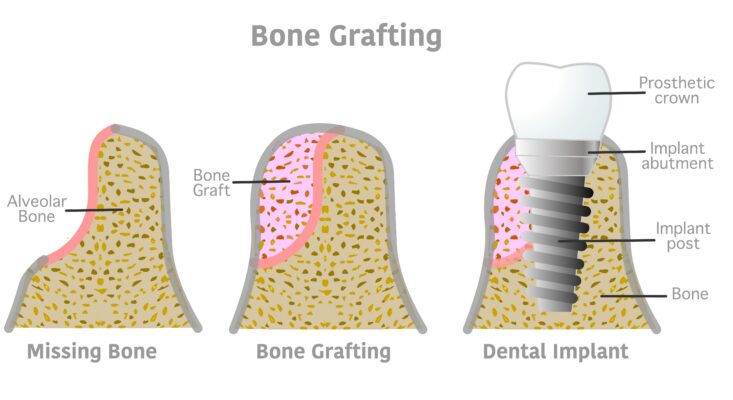
A bone graft adds bone or bone-like material to an area that has lost volume. As the area heals, your body builds new bone around the grafted material, creating more height, width, or support for a dental implant.
An implant needs enough solid bone around it to remain stable, not just bone underneath it. If the jaw is too narrow or lacks enough density, rebuilding the area can provide the foundation the implant needs for long-term support.
Why Implant Size Can Change Your Treatment Plan
Dental implants come in different lengths and widths. Length refers to how far the implant extends into the jaw, while width describes its diameter. Both dimensions have to fit safely within the available bone.
A few millimeters can make a difference. Conventional dental implants average about 5 millimeters in diameter, while the mini dental implants we use at Carolina Dental Arts measure less than 3 millimeters across. A wider implant requires more room within the jaw, with enough bone surrounding it for support. A mini implant has a much narrower footprint and requires less bone for placement.
For someone with a narrow jawbone, the difference in implant diameter can lead to very different treatment plans. We might rebuild the area with a bone graft to accommodate a conventional implant. In other cases, a mini implant may fit securely within the bone already available, reducing or eliminating the need for grafting.
How Do I Know If I Have Enough Bone for Implants?
You can’t tell how much bone you have by looking in the mirror or guessing based on how long your tooth has been missing. At Carolina Dental Arts, we answer that question during your implant evaluation. We review your medical and dental history, examine your mouth, and use 3D imaging to take a closer look at your jaw.
Our cone beam computed tomography (CBCT) scanner shows us the height, width, and depth of the available bone. With that information, we can plan the implant’s position and determine which size can fit safely within the area.
Finding bone loss does not automatically mean adding a bone graft. We also consider the location of your missing tooth, the quality of the bone, and the type of implant it needs to support. Your scan may show enough room for a traditional implant, point to a bone graft as part of the plan, or show that a smaller mini implant can work with the bone you already have.
Find Out If You Really Need a Bone Graft
Bone loss can change an implant plan, but it doesn’t dictate what your plan has to be. At Carolina Dental Arts, your free implant consultation gives us the information we need to compare your options based on your jaw, your missing teeth, and the type of replacement you need.
If concerns about bone loss or a bone graft have kept you from moving forward with dental implants, come talk with us. Schedule your free consultation at one of our 3 locations in Durham, Raleigh, and Goldsboro to find out which implant approach fits your needs.